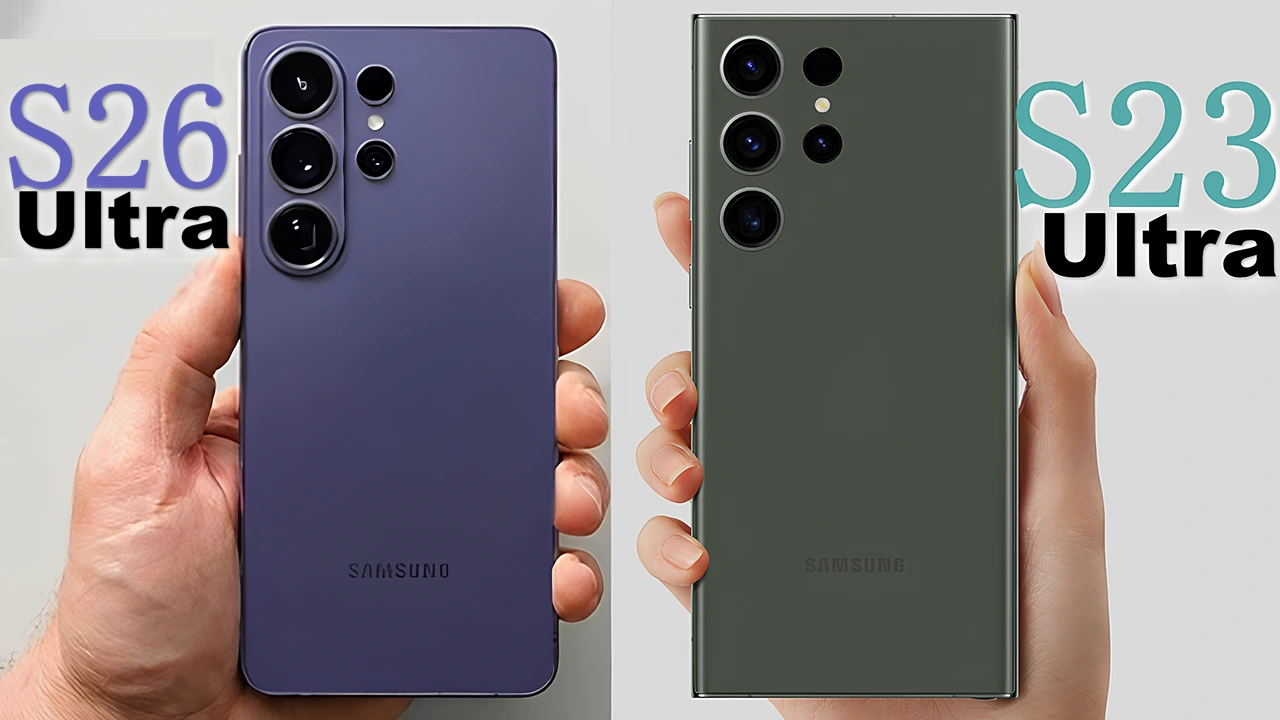
Samsung Galaxy S23 Ultra was its best-selling phone in 2023.
The S Pen kept the Note’s heritage alive, and it was the first Ultra to completely commit to a 200 MP primary camera and the one that made Snapdragon the standard throughout the world.
Three years later, Samsung doesn’t sell it anymore, but you can still buy it secondhand or refurbished for a lot less than the four-figure price of a brand-new Ultra.
The Galaxy S26 Ultra is coming out soon, however, and it is rumored to include a lot of improvements that will make it an even better flagship.
First of all, the display is said to be a lot brighter and better. There are also rumors of a new and unique display function that would improve privacy.
The S26 Ultra is claimed to contain Qualcomm’s next Snapdragon CPU, faster charging, and better hardware for the main camera, in addition to the display improvements.
Note: Recent and consistent leaks now point to a delayed launch. Samsung is expected to show off the Galaxy S26 series during a Galaxy Unpacked event on February 25, 2026.
It is expected that the product will be available in stores in early March. The S26 series will now come a bit later than previous Galaxy S models, but it will still be ahead of the longer delays that were previously thought to happen in March.
If you decide to upgrade to the next model when it comes out, this comparison looks at how the three-generation jump may make your experience better.
The Galaxy S23 Ultra had flat corners and curved glass that barely went over the screen. This made it seem a lot like the boxy Ultra design. It genuinely seemed like the Note’s successor since it had an S Pen, IP68 protection, and tough Gorilla Glass Victus 2.
- The Galaxy S26 Ultra’s frame material is another noticeable improvement.
Samsung is anticipated to replace the titanium that came with the S24 Ultra with the newer Armor Aluminum 2.0, in contrast to the Galaxy S23 Ultra, which included Armor Aluminum with Gorilla Glass Victus 2.
Since aluminum transfers heat significantly more efficiently, going back to it should boost thermal performance. Additionally, it would aid in reducing expenditures, which is especially critical in light of escalating component prices.
The S26 Ultra should be roughly 0.4 mm thinner than the S25 Ultra and nearly a full millimeter thinner than the S23 Ultra, according to recent estimations. Its softened edges and softer, less angular appearance are also suggested by leaking casings.
The camera module might be the cause of the biggest visual modification. To accommodate bigger lenses, Samsung may switch out the individual rings for a single camera island.
Additionally, according to sources, Samsung is enhancing the camera design by replacing the obsolete “vinyl “record”-style rings with metal rings and a pill-shaped camera bar.
The overall result ought to be a more coherent, cleaner look that better suits the S26 Ultra’s smaller frame.
2. Show Disparities.
A 6.8-inch QHD+ OLED display with a maximum brightness of 1,750 nits and exceptional low-brightness management was implemented in the Galaxy S23 Ultra.
Samsung’s groundbreaking M14/CoE OLED stack, which enhances efficiency and light transmission and minimizes internal reflections, is projected to be utilized in the Galaxy S26 Ultra.
Additionally, it has been rumored that Samsung is testing a feature termed “Flex Magic Pixel” that is tied to a new “Privacy Display” option.
Even at high brightness, it is meant to keep the screen clear when viewed head-on while restricting side-angle vision and preventing shoulder-peeking.
According to recent sources, Privacy Display won’t be ultra-exclusive but will instead be accessible on the complete Galaxy S26 series.
Nevertheless, it would still be a substantial upgrade over the Galaxy S23 Ultra’s standard screen in terms of display.
3. Software and Performance.
By standardizing the Snapdragon 8 Gen 2 for all Galaxy devices and bringing considerable increases in CPU and GPU performance as well as longer battery life without increasing battery capacity, the Galaxy S23 Ultra signaled a sea shift.
The Galaxy S26 Ultra is predicted to transition to the Snapdragon 8 Elite Gen 5 for Galaxy, which is based on an enhanced 3 nm technology, three generations later. Stronger sustained performance should come from faster GPU and NPU performance, higher clocks, and improved cooling.
A Snapdragon-only Galaxy S26 Ultra is now clearly revealed by recent FCC documentation, despite prior allegations that the Ultra will be powered by an Exynos 2600 in some places.
Since the documents only feature Qualcomm modems and make reference to Qualcomm-specific radio functions, it is extremely plausible that Exynos will be preserved for the regular S26 and S26 Plus.
There are claims that the Snapdragon 8 Elite Gen 5 Samsung Galaxy will have a clock speed of up to 4.74 GHz.
Additionally, it boasts the new Adreno 840 GPU, which is supposed to give graphics performance that is roughly 30% better than the chip from the previous year.
Together with enhanced energy economy when utilizing mobile data, it should enable greater 5G speeds of up to 12.5 Gbps downlink when paired with Qualcomm’s X85 modem.
Additionally, Chinese certification documents reveal that the Galaxy S26 Ultra, at least the Chinese version, enables emergency satellite messaging.
Although it’s questionable if this capability will be available everywhere, it’s a huge advance over the S23 Ultra.
Additionally, the RAM is apparently being upgraded to Samsung’s most current generation of memory, 1-gamma LPDDR5X, which is 20% more power-efficient than the 1-beta version and supports up to 10.7 Gbps speeds.
Wi-Fi 7 and Bluetooth 5.4 also increase communication, resulting in speedier wireless performance and more reliable accessories.
Software-wise, the S26 Ultra should arrive with Samsung’s seven-year update promise along with Android 16 and One UI 8.5.
In contrast, the S23 Ultra’s final year of software support is soon approaching. The last Android version the S23 Ultra will receive is Android 17, because Samsung pledged four years of OS updates and five years of security patches for that generation.
According to rumors, Samsung is also modifying the manner in which it offers new AI capabilities.
According to early reports, the Galaxy S26 Ultra would be the first to gain some of the Galaxy AI upgrades, with prior flagships like the S23 Ultra getting them months later instead of all at once.
4. Camera.
By combining that main camera with a typical quad configuration—12 MP ultrawide, 10 MP 3x, and 10 MP 10x periscope—as well as a 12 MP selfie camera, the Galaxy S23 Ultra inaugurated Samsung’s 200 MP era. The wider punch hole is explained by the broader 85-degree lens utilized by that front camera.
Rumor has suggested that the S26 Ultra will contain a wider f/1.4 lens and either the same HP2 sensor or a larger, roughly 1/1.1-inch 200 MP sensor.
Either adjustment would boost the camera’s dynamic range, capture more light, and generate more realistic background blur.
Confusion concerning the 3x camera has also been cleared up by recent sources. Instead of introducing a new 12 MP telephoto, Samsung is believed to remain with a 10 MP 3x telephoto, but the sensor might be a little bit smaller to suit the thinner chassis.
Since the S23 Ultra, Samsung has also adjusted its policy regarding telephoto cameras. According to sources, the corporation has swapped out the extreme 10x camera with a more practical 5x telephoto with a larger sensor, which should result in much greater image quality at ordinary zoom ranges.
Additionally, Samsung is extending the 5x telephoto camera’s aperture, which should boost low-light zoom shots.
The resurrection of variable aperture, which was last seen on the Galaxy S9, is among the most fascinating rumors.
Without being fully dependent on software, the lens could physically flip between f/1.4 and f/2.4, helpful in balancing low-light performance and depth of focus.
In order to catch up to the iPhone’s cinematic video, Samsung is supposedly inventing a new APV format with high- and low-quality options, better HDR processing, and stronger audio recording capabilities.
The New video controls, such as the ability to vary the autofocus transition speed and also adjust the video’s softness, are also denoted by one UI 8.5 code.
For two years straight, the Galaxy Ultra series has achieved the top camera score. Samsung may boost that edge even further with greater audio, sharper HDR, and improved stability.
5. Charging and Battery Life:
In our tests, the S23 Ultra outlasted its predecessor despite having the same capacity, showcasing what an excellent CPU can achieve with a 5,000 mAh battery.
However, charging rates remained consistent at 45W.
Recent certification listings show Samsung is sticking with a 5,000 mAh battery for the Galaxy S26 Ultra, despite recent suspicions of a small capacity increase.
Therefore, efficiency increases rather than a larger cell are predicted to be the source of any real-world battery life improvements.
These days, quicker charging seems much more plausible than bigger batteries. A big jump to cable charging for the Galaxy S26 Ultra is strongly indicated by Samsung-listed 60W PD 3.1 chargers.
According to recent sources, the S26 series won’t contain embedded magnets, although wireless charging may grow to 25W..
I would absolutely feel the difference if I converted from a Galaxy S23 Ultra to the S26 Ultra. Jumping three generations at once adds up to a substantial difference, even if the S26 Ultra turns out to be a slight improvement over the S25 Ultra.
The new 5x telephoto camera, the anti-reflective display, the speedier charging with probable magnetic support, and the more modern, powerful CPU are the upgrades I would notice straight away.
I would be aware that my S23 Ultra is due to receive Android 17 in 2026 along with an extra year of security upgrades if it were still running correctly.
It’s getting old, however. Moving to a newer Ultra is frequently much easier to rationalize thanks to Samsung’s trade-in offers and launch storage upgrades.
Read More.