
Another day, another foldable iPhone rumor, but this one targets the single biggest complaint about foldables: the crease. A well-known tipster now claims Apple has achieved what many buyers want most, a “seamless” crease-free internal display for its long-rumored foldable iPhone, increasingly referred to as the iPhone Ultra.
According to the leak, Apple has also effectively locked in the hinge and panel approach, despite recent chatter that hinge engineering has been a sticking point. If true, it signals the project is moving from “still experimenting” to “design is stable enough for the supply chain,” a meaningful shift for a product reportedly aiming at late 2026 production targets.
What the latest leak claims (and why it matters)
The headline claim is simple: Apple has reached a no-crease (or functionally no-crease) foldable display. That matters because the visible dip down the center is still the defining compromise of today’s foldables. Some manufacturers reduce it, few truly remove it, and many devices develop a more obvious line after days or weeks of opening and closing.
The tipster says Apple’s solution resembles what Oppo has done on its Find N-series, specifically a hinge and panel pairing designed to minimize stress at the fold. Reviews of Oppo’s approach often praise a subtler crease out of the box, but also note it can become more noticeable with use. Apple’s reported stance is stricter: no mass production until the crease is effectively “zero feel.”
That kind of requirement would be consistent with Apple’s typical product philosophy. Apple can tolerate a tradeoff (like weight or cost) more readily than a highly visible quality flaw that every owner sees multiple times a day. If the crease is gone or nearly invisible, Apple gets to pitch the foldable not as a compromise device, but as a premium iPhone that happens to unfold into something closer to an iPad mini.
The hinge: Liquidmetal, 3D printing, and a flatter fold)
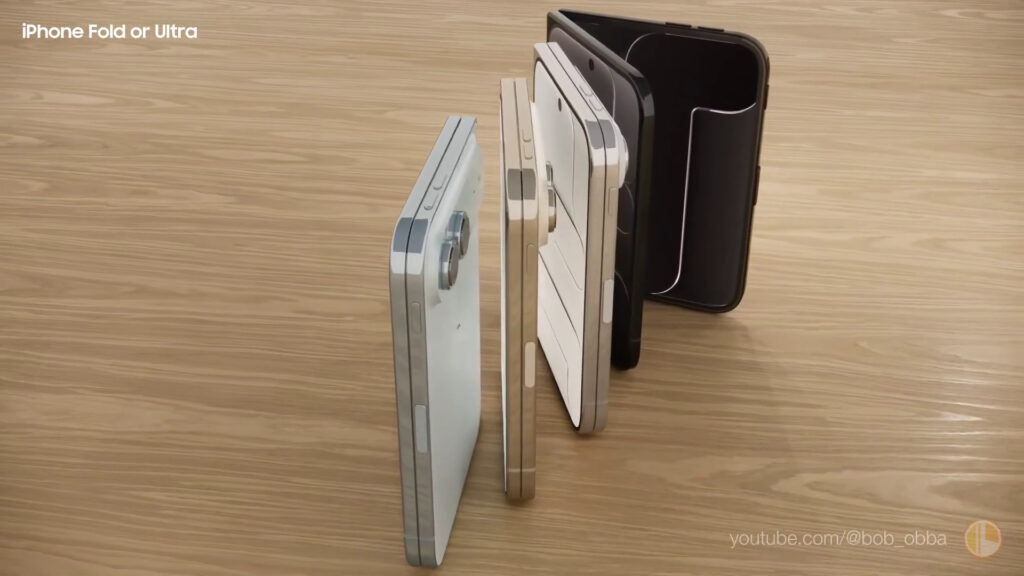
If the display is the headline, the hinge is the story underneath it. A foldable hinge does more than connect two halves; it helps define how the screen bends, how evenly it’s supported, and how flat it sits when opened. Poor support can increase crease visibility and long-term fatigue, and it can also raise the risk of damage from pressure during everyday use.
Rumors have repeatedly pointed to Liquidmetal as a key material. The logic is straightforward: it resists bending and denting and is often described as significantly harder than common alloys while staying relatively light. One recent leak suggested the main casing could blend titanium and Liquidmetal, with Liquidmetal used specifically in the hinge. Another claim says the Liquidmetal formulation could be an improved version of what Apple used years ago in a humble place: the SIM eject tool.
Manufacturing methods are also part of the speculation. An April rumor mentioned “chip-level high-molecular 3D printing technology” for hinge parts. That phrasing is hard to validate from the outside, but the broader point tracks: to reduce the crease, you need tight tolerances and complex geometry, and advanced manufacturing can help.
One earlier rumor even quantified the goal, claiming Apple’s crease depth could be roughly a quarter of the Galaxy Fold 7. Whether or not that comparison holds up, the direction is clear: the hinge is where Apple plans to win.
Cameras, specs, software, and the likely price shock)
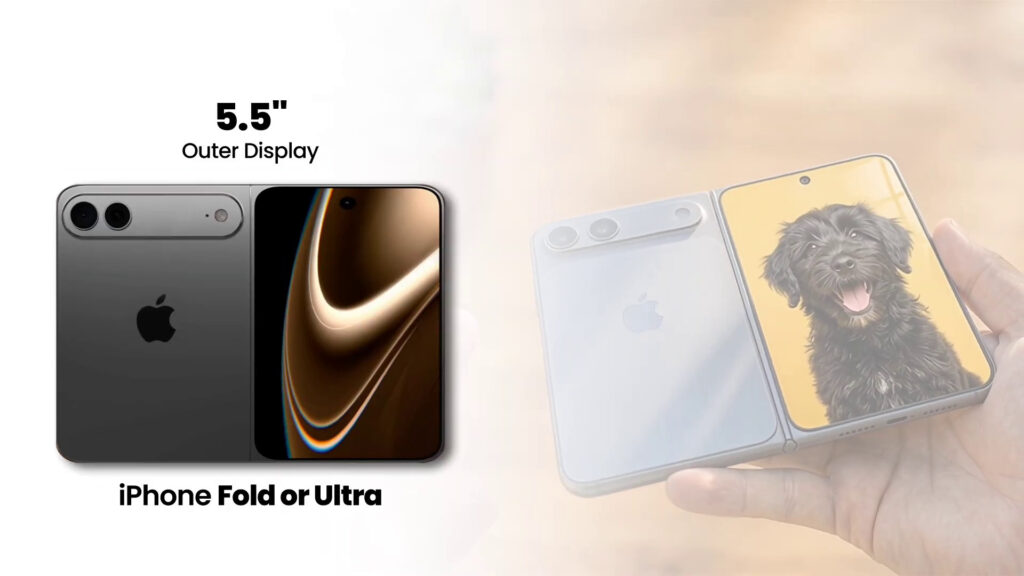
A foldable iPhone still has to be an iPhone, which means cameras and daily usability won’t be optional. Several rumors suggest Apple could use a bar-style Camera Plateau across one enclosure half. Besides housing lenses, that space could fit components that would otherwise compete with the hinge, battery, and display stack.
Leaks point to two rear cameras arranged horizontally, possibly 48MP sensors with different focal lengths, plus specific multi-element lens stacks (often cited as 7-piece and 6-piece). For selfies and calls, the outer display may use a punch-hole camera, while the inner display could move to an under-display camera to avoid notches or cutouts on the main screen.
Biometrics are another twist. Some reporting expects no Face ID, instead leaning on Touch ID, potentially under-display. That choice would simplify internal packaging and reduce cutouts, though it would be a notable shift for a flagship iPhone.
As for performance, one analyst note suggests an A20-class chip, 12GB RAM, and an Apple-designed modem. The bigger chassis could enable Apple’s largest iPhone battery yet. Software, likely iOS 27 for that release window, may add iPad-like multitasking such as side-by-side apps and in-app sidebars.
Price expectations remain high: most forecasts cluster above $2,000, with some capacity-based leaks suggesting roughly $2,325 for 256GB, around $2,645 for 512GB, and close to $2,905 for 1TB.
What it could mean for a foldable iPad (and Apple’s timing)
The most intriguing add-on is the claim that this hinge and panel tech could “trickle down” to a foldable iPad, potentially forming the backbone of an iPad/MacBook Fold style device. If Apple perfects a crease-free fold at iPhone scale, it gains confidence, suppliers, and processes to attempt a much larger display, where any crease would be even more obvious.
Timing also fits Apple’s playbook. Start with the highest-volume halo product (iPhone), refine the mechanics, then extend the platform to iPad once durability and yields stabilize.
Conclusion
For now, this remains a leak, but it’s a meaningful one because it claims Apple has cleared the biggest visual hurdle: the crease. If Apple can truly deliver a foldable that opens flat, stays smooth over time, and runs iOS with real multitasking, the iPhone Ultra could be the first foldable that feels less like a tech demo and more like a mainstream flagship. The only catch may be the simplest one: the price tag.
Read More!