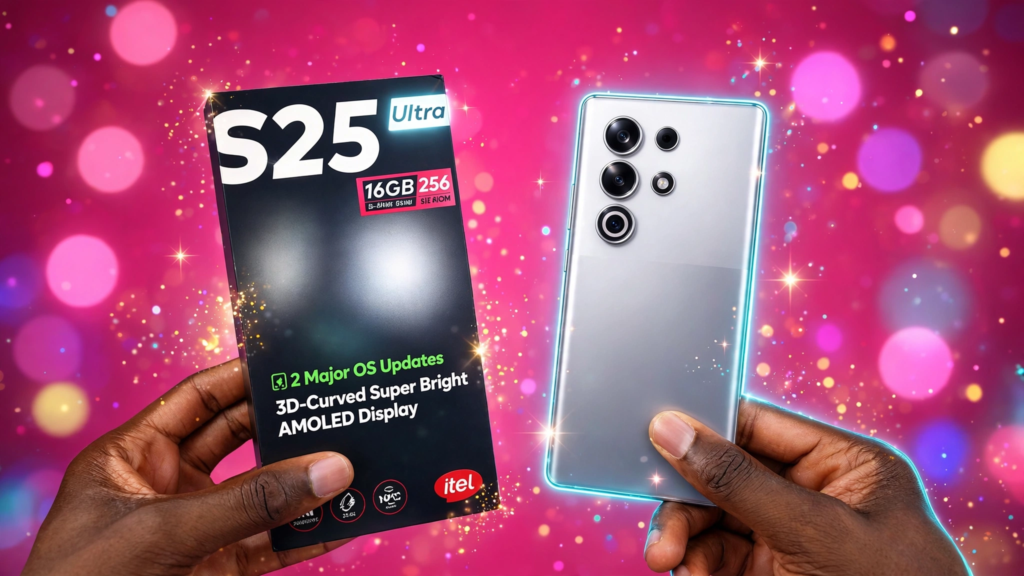

When you pull the itel S25 Ultra out of the box, the first impression is unmistakable: it mirrors a premium flagship from the rear, front, and sides. The device’s 6.9 mm ultra‑slim chassis feels surprisingly light, while its 3D‑curved AMOLED display seems to flow into the frame, a design cue most associated with flagship models costing $1,000 or more.
The “viral” element of this aesthetic is obvious. Hold the phone up to a camera, and viewers often experience a double‑take—trying to guess whether it’s a flagship or a budget device. The visual deception creates instant shareable moments on TikTok, Instagram Reels, and YouTube tech reviews, turning the phone’s appearance into a marketing tool in itself.
The 3D‑Curved AMOLED Appeal
- Depth and immersion – The gently curved edges draw the eye across the screen, enhancing media consumption.
- Premium feel – The seamless edge-to-edge panel eliminates the “plastic” look that many budget phones retain.
- Cost‑effective manufacturing – itel leverages partnerships with display suppliers that already produce high‑end panels for flagship devices, allowing the S25 Ultra to adopt the same technology without the premium markup.
Premium Hardware Features on a Budget (Gorilla Glass 7i & IP64)
Corning Gorilla Glass 7i – A Rare Find at This Price
Corning’s Gorilla Glass 7i is typically reserved for devices that command a higher price tag. It offers enhanced scratch resistance and improved drop performance compared to earlier iterations. For the itel S25 Ultra, this means:
- Everyday durability – Keys, coins, or accidental tumbles are less likely to damage the screen.
- Longevity – The glass maintains clarity over years of use, reducing the need for costly screen replacements.
While many budget phones skimp on screen protection, the inclusion of Gorilla Glass 7i signals that itel has prioritized real-world durability, not just a glossy marketing claim.
IP64 Rating – Water Resistance Without the Price
An IP64 rating provides protection against splashing water from any direction, a feature usually found on mid‑range or flagship phones. This offers users peace of mind when:
- Cooking in the kitchen and accidentally splashing water.
- Outdoor activities like hiking or beach trips where sudden rain is possible.
The combination of Gorilla Glass 7i and IP64 demonstrates that the S25 Ultra doesn’t compromise on build quality, delivering features typically reserved for devices costing twice as much.
2160 Hz PWM Dimming – Smoother Screens, Better Battery Life
Pulse‑Width Modulation (PWM) dimming influences how the display renders brightness changes. The S25 Ultra’s 2160 Hz PWM is significantly higher than the standard 240 Hz or 360 Hz found on many budget phones. Benefits include:
- Reduced flicker – Higher frequency dimming is less noticeable to the human eye, leading to a more comfortable viewing experience.
- Improved battery efficiency – The display can lower brightness in small increments, conserving power during static scenes.
This technical detail may seem niche, but it contributes to a more refined user experience, aligning the S25 Ultra with premium standards.
In‑Display Fingerprint Scanner – Seamless Security
Security features often trickle down from flagship to mid‑range devices. The S25 Ultra integrates an in‑display fingerprint scanner, allowing users to unlock the phone with a simple touch on the screen. Advantages include:
- Speed – Unlocking is instantaneous, comparable to flagship implementations.
- Convenience – No need for physical buttons or rear sensors that can be prone to wear.
RGB Ring Notification Light – A Touch of Personality
The rear of the S25 Ultra houses an RGB ring notification light, reminiscent of customizable LED strips found on high‑end gaming phones. This feature adds a personalized flair:
- Custom colors – Users can assign different colors for calls, messages, or app alerts.
- Visibility – The light is easily seen even when the phone is face‑down, providing subtle notifications.
These hardware highlights collectively subvert expectations of what a budget‑priced phone can achieve, reinforcing the device’s “premium on a budget” narrative.
The Bypass Charging & Gaming Party Trick
What Is Bypass Charging?
Bypass charging technology powers the motherboard directly, sidestepping the battery during intensive tasks such as gaming. Instead of drawing current through the battery, the phone routes power straight from the charger to the CPU and GPU. This approach delivers several advantages:
- Reduced heat – By bypassing the battery, the device generates less thermal load, keeping the phone cooler.
- Sustained performance – Without battery‑related throttling, the phone can maintain higher clock speeds for longer periods.
Real‑World Gaming Demonstration
Tech reviewers have put the S25 Ultra through 30‑minute gaming marathons in titles like Genshin Impact and PUBG Mobile. The results consistently show:
- Stable frame rates – No noticeable drops in FPS, even under heavy graphical loads.
- Lower device temperature – The phone’s surface temperature remains several degrees cooler than comparable devices without bypass charging.
These findings provide a compelling value proposition: a budget phone that can handle demanding games without overheating, a feature that traditionally required flagship‑level hardware.
Why It Matters for Budget Tech Channels
For content creators focusing on affordable devices, the bypass charging capability offers a unique selling point that differentiates the S25 Ultra from other entry‑level phones. It gives reviewers a concrete, measurable benefit to showcase, turning a simple price‑point discussion into a deeper performance analysis.
The Unisoc Reality Check (The Performance Trade‑Off)
The Processor: Unisoc T620
At the heart of the S25 Ultra lies the Unisoc T620 SoC. While not as widely recognized as Snapdragon or MediaTek chipsets, the T620 is positioned as an entry‑level processor designed for cost efficiency. Its specifications include:
- 4‑core CPU architecture, optimized for power saving rather than raw speed.
- Mali‑G57 GPU, adequate for casual gaming and everyday UI navigation.
The T620 delivers sufficient performance for basic tasks—browsing, social media, streaming video—but may struggle with resource‑intensive applications or sustained high‑load gaming.
18 W Charging Speed – A Trade‑Off in Convenience
Charging speed is another area where the S25 Ultra diverges from flagship expectations. The device supports 18 W fast charging, which, while respectable for a budget device, is modest compared to the 30 W, 45 W, or even 65 W chargers found on premium phones. Implications include:
- Longer charge times – A typical 4,500 mAh battery may take around 1.5–2 hours to reach full capacity.
- Reduced heat generation – Lower wattage charging produces less heat, contributing to overall device stability.
Performance vs. Design: Does the Aesthetic Justify the Compromise?
The central debate surrounding the S25 Ultra revolves around whether its jaw‑dropping exterior design can compensate for the entry‑level performance dictated by the Unisoc T620 and 18 W charging.
- Pro‑design arguments – The phone’s sleek silhouette, premium‑looking display, and robust build quality create a perception of high value, potentially justifying a lower performance ceiling for users who prioritize style and durability.
- Performance‑first arguments – Users who demand smooth multitasking, rapid app launches, or high‑fps gaming may find the T620’s limitations frustrating, especially when compared to the thermal headroom offered by more powerful chipsets.
Community Debate
Comment sections across review platforms reveal a split audience:
- Design enthusiasts praise the phone’s “flagship look” and see the modest internals as an acceptable trade‑off for the price.
- Performance seekers criticize the T620 for occasional lag, slower app opening, and limited gaming headroom, urging buyers to consider alternatives with stronger processors.
This polarity fuels lively discussion, making the S25 Ultra a hot topic in budget‑phone circles.
Conclusion
The itel S25 Ultra embodies a bold experiment in the budget smartphone market: it offers a flagship‑inspired aesthetic, premium hardware touches like Gorilla Glass 7i, IP64 water resistance, high‑frequency PWM dimming, an in‑display fingerprint scanner, and an RGB notification ring—features rarely bundled at its price point. Its bypass charging technology adds a unique gaming advantage, allowing sustained, cooler performance during extended play sessions.
However, the Unisoc T620 processor and 18 W charging introduce noticeable performance constraints that may deter power users. Ultimately, the S25 Ultra succeeds in redefining expectations for entry‑level devices, delivering a compelling blend of style, durability, and select flagship‑grade features. Whether its striking design outweighs the performance trade‑off will depend on individual priorities, but there is no denying that the phone has sparked conversation, generated viral moments, and proven that budget phones can still feel premium.
In a market where differentiation is increasingly difficult, the itel S25 Ultra stands out as a testament to daring design paired with thoughtful hardware choices, inviting consumers to reconsider what a sub‑$300 phone can truly achieve.