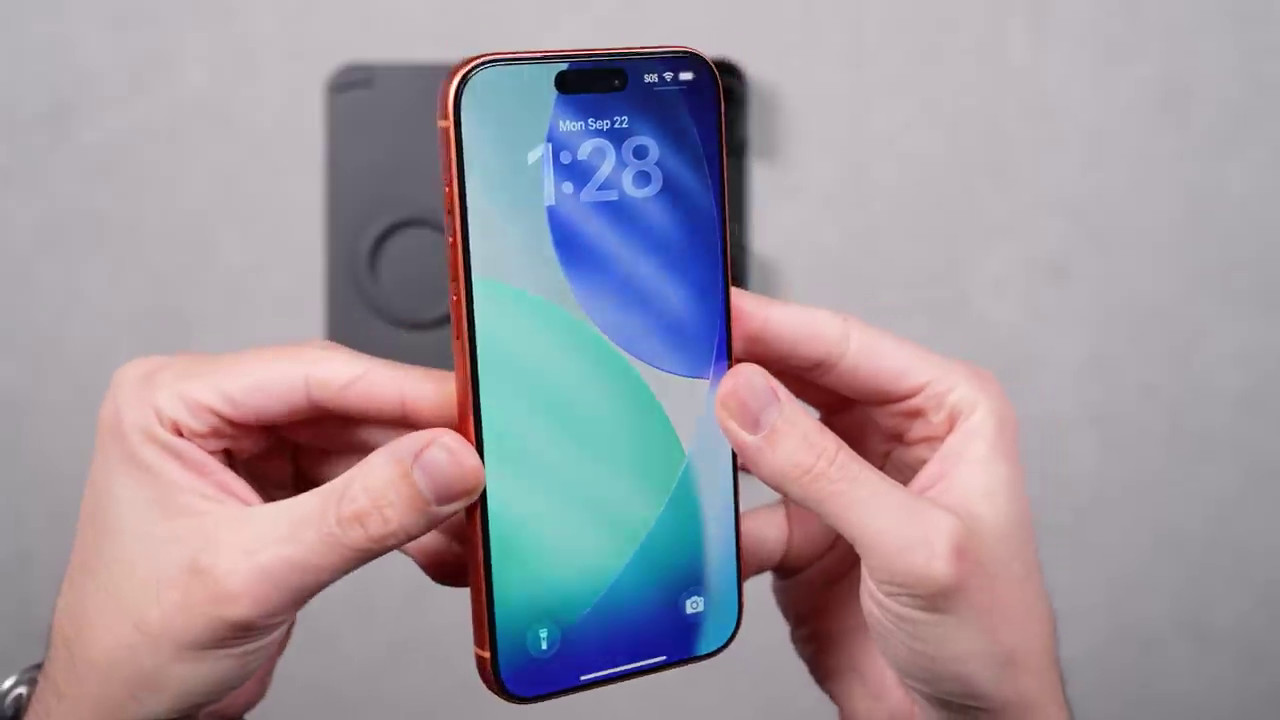
Apple is preparing customers for higher prices, and a new analysis suggests the iPhone 18 Pro could be the clearest example yet. After Apple CEO Tim Cook acknowledged that the company is being hit by rising memory chip costs, The Wall Street Journal published an estimate that the iPhone 18 Pro could start as high as $1,399 if Apple tries to protect its typical margins.
Apple has not confirmed iPhone 18 pricing. But Cook’s comments, paired with an industry-wide squeeze on DRAM and NAND flash, have shifted the conversation from “will prices rise?” to “how high can they go without hurting demand?”
Why a $1,399 iPhone 18 Pro is suddenly plausible
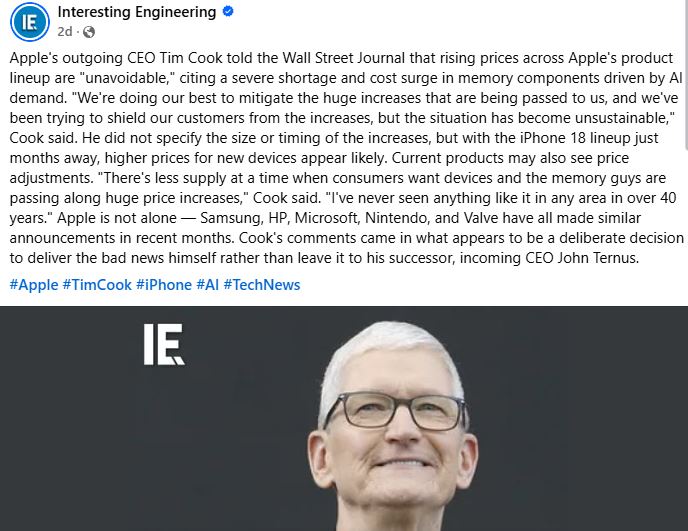
The headline number comes from a simple but uncomfortable premise: if key components get dramatically more expensive, retail prices usually follow. Speaking to The Wall Street Journal, Cook said Apple is “not immune” to soaring memory costs and added that the company is still working through which devices will see price increases and when. Apple is expected to provide clearer guidance around its next iPhone lineup announcement in September.
The Wall Street Journal’s pricing range is notable because it frames $1,399 not as a luxury outlier, but as a rational outcome if Apple sees cost increases as structural rather than temporary. That’s a different kind of pressure than the incremental, year-over-year bumps consumers are used to.
A $1,399 starting point would be a $200 to $300 jump over the current iPhone 17 Pro’s $1,099 entry price, reshaping the value argument for buyers who typically default to “Pro” for the best camera and display without going all the way to a Max model.
The memory crunch behind Apple’s coming price hikes
The root cause, according to the reporting, is a global shortage of two essential smartphone components: DRAM (system memory) and NAND flash (storage). What makes this shortage different is who Apple is competing with.
AI data centers are consuming massive volumes of memory, and suppliers have been shifting production toward enterprise-grade memory parts used in servers. Samsung Electronics and Micron Technology are among the manufacturers cited as moving capacity toward those higher-margin AI-focused components, tightening supply for consumer electronics.
The Journal, citing analysis from TechInsights, reports that DRAM and flash pricing is projected to roughly quadruple by this fall compared to last year. Even if “quadruple” ends up being directionally right rather than perfectly precise, Apple sells at a scale where even a $10 swing in component costs matters. When the swing is measured in tens of dollars per phone, the pressure becomes hard to absorb quietly.
What the numbers say: bill of materials vs retail pricing
TechInsights’ estimates, as summarized by The Wall Street Journal, put concrete figures behind the coming sticker shock.
For the iPhone 17 Pro, TechInsights estimates Apple paid roughly: – $39 for 12GB of DRAM – $13 for 256GB of flash storage
For the iPhone 18 Pro, those could rise to about: – $145 for DRAM – $51 for flash storage
TechInsights also estimates that Apple’s component and manufacturing costs for the iPhone 17 Pro, excluding memory, are roughly $530. Add the memory costs and you get an estimated bill of materials around $582 for the base iPhone 17 Pro. For iPhone 18 Pro, the estimate rises about 25% to around $726.
The pricing question then becomes a margin question. TechInsights suggests the $1,099 iPhone 17 Pro carries a gross margin around 47%. If Apple wanted to preserve that same margin on a $726 bill of materials, The Wall Street Journal says the math points to roughly $1,371.
But Apple also tends to prefer clean, standardized price steps, which is why the Journal says a $1,299 starting price could be more likely, even if it implies a lower margin around 44%.
So why does $1,399 re-enter the picture? Cameras. Supply chain analyst Ming-Chi Kuo has suggested a new camera system could cost Apple about 50% more than the previous generation. If that’s true, and if Apple applies the same pricing logic, The Wall Street Journal estimates Apple could set the starting price at $1,399 or higher.
In other words, the memory shock may set the baseline for price increases, while a meaningful camera hardware jump could push the Pro line into a new bracket.
iPhone 18 Pro Max: familiar design, bigger battery rumors
While price and component costs are grabbing the headlines, new leaks suggest the physical design may not change much, at least for the iPhone 18 Pro Max.
Leaker Ice Universe posted on Weibo that the iPhone 18 Pro Max could be almost identical to the iPhone 17 Pro Max in dimensions, including the same reported thickness of 8.75 mm, with a height of 163.4 mm and a width of 78 mm. If accurate, that would contradict earlier chatter about a taller, narrower redesign.
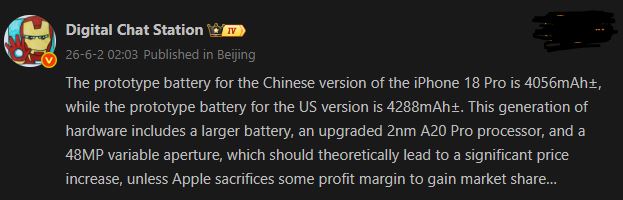
Other rumors point to internal upgrades rather than a new silhouette. Leaker Digital Chat Station has suggested Apple could push battery capacity above 5,000 mAh, possibly in the 5,100 to 5,200 mAh range. That would be a clear step up from the iPhone 17 Pro Max’s reported 4,823 mAh battery, and it would put Apple in a more competitive position against the biggest-battery Android flagships.
There’s also talk of expanded satellite capabilities beyond today’s Emergency SOS implementation, plus a variable-aperture camera system that could give users more control over depth of field and low-light performance.
What to watch ahead of Apple’s September iPhone event
Pricing will likely become a broader lineup story, not just a Pro story. If Apple raises the iPhone 18 Pro to $1,299 or $1,399, it has to decide how to keep the rest of the range coherent: the standard model, the Plus (if it remains), and the Max tier.
One reason the iPhone 18 Pro Max matters here is Apple’s typical $100 gap between Pro and Pro Max. If that holds, a $1,399 iPhone 18 Pro implies a $1,499 iPhone 18 Pro Max. That’s before any carrier promotions, trade-in boosts, or storage-tier upsells.
Finally, the rumored foldable “iPhone Ultra,” often discussed at around a $2,000 starting price, could change how Apple positions the Pro line. A higher-priced halo device can make $1,399 feel less shocking in a lineup, even if it still represents a major jump for mainstream buyers.
Conclusion
The most important takeaway from The Wall Street Journal’s report isn’t that $1,399 is guaranteed, but that the economics now support a much higher starting point than recent iPhone history would suggest. If DRAM and NAND costs spike anywhere near TechInsights’ projections, Apple will either accept lower margins, adjust specs, or raise prices.
With Apple expected to clarify its pricing outlook around the September launch window, the key questions are whether memory costs ease in time, whether camera upgrades land as a must-have leap, and how far Apple believes its Pro audience will follow it up the price ladder.
Read More!