For the past couple of weeks, the iPhone 18 Pro rumor mill has felt less like typical spec-watching and more like financial planning. After Apple CEO Tim Cook said a price increase is “unavoidable,” the conversation quickly shifted from cameras and chips to a single question: how much more is “unavoidable,” exactly?
Some estimates have been eye-watering. But a new read from J.P. Morgan, circulated via analyst chatter, suggests the iPhone 18 Pro price hike may end up far smaller than many feared. If that holds, Apple could pull off a rare trick: raise prices while making customers feel relieved.
Why everyone’s bracing for a big iPhone 18 Pro jump
The fear started with math. TechInsights has argued that to maintain Apple’s current iPhone profit margins, the iPhone 18 Pro may need a price increase on the order of $270. The Wall Street Journal ran its own numbers and floated a possible jump from the iPhone 17 Pro’s $1,099 starting point to around $1,399 or more for the iPhone 18 Pro.
Those estimates aren’t coming out of nowhere. They’re based on a familiar Apple formula: keep margins steady, then add cost increases from key components. This year’s suspected trouble spots are storage, memory (RAM), and some camera parts, with memory being the headline issue.
Once consumers hear “$300 increase,” it tends to stick. It becomes the anchor price people prepare for, complain about, and eventually compare everything else against. That’s why any counter-forecast, especially from a big Wall Street shop, is getting a lot of attention.
The real culprit: AI data centers squeezing memory supply
The pressure on iPhone component costs isn’t just about Apple deciding to be greedy. The supply chain has a legitimate squeeze, and it’s coming from the AI boom.
Demand for AI data centers has been pulling the entire memory industry upward and sideways at the same time. Memory makers like Samsung, Micron, and SK Hynix have been shifting capacity toward High-Bandwidth Memory (HBM) and higher-end server DRAM because the margins are better and the demand is intense.
That decision has consequences. Wafer starts, cleanroom time, packaging capacity, and engineering attention are finite. When more of that capacity is allocated to premium AI-focused products, the “regular” memory parts used in smartphones can get tighter. Even if phone demand stays flat, reduced supply can push prices up. That’s Econ 101 with a fab schedule.
This is why Cook’s “unavoidable” comment landed: it lines up with real, industry-wide constraints, not just Apple’s internal planning.
J.P. Morgan’s call: keep the increase to around $50
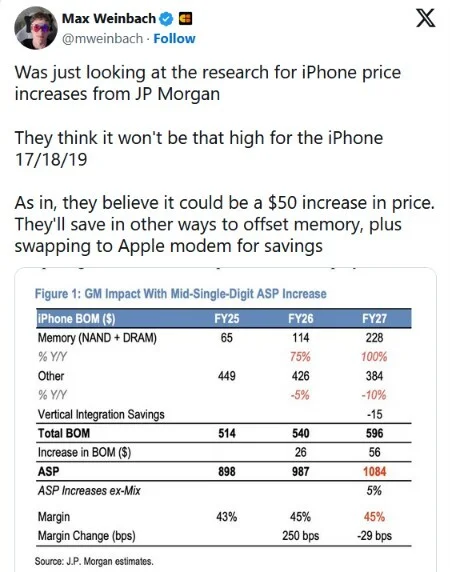
Now for the cooling water. According to a research note attributed to J.P. Morgan and referenced publicly by analyst Max Weinbach, the bank expects iPhone price increases to be much more modest across upcoming generations. The key claim: Apple may raise prices by no more than $50 on models like the iPhone 17, iPhone 18, and even the iPhone 20.
If that’s the target, Apple would be choosing a different lever than “pass all costs to customers.” Instead, it would likely lean on cost controls and bill-of-materials optimization to protect margins. One widely discussed method is using more Apple-designed components, including an Apple C-series modem, which could lower dependency on third-party pricing and reduce per-unit costs over time.
A $50 bump also fits consumer psychology. It’s noticeable, but it doesn’t instantly force a big chunk of buyers to rethink upgrades, carrier deals, or monthly payment plans. Apple wants to protect the upgrade treadmill, not jam it.
Tim Cook’s expectation-setting and Apple’s pricing playbook
There’s also a communications angle here, and it’s classic Apple-era Cook.
By saying a price increase is unavoidable during a very real memory shortage, Apple effectively let the market talk itself into expecting a $300 jump. If the actual increase lands closer to $50, the headline becomes “better than feared,” not “Apple raises prices again.” That’s not an accident; that’s expectation management.
Apple has done versions of this before, sometimes using product configuration as the “softener.” In September 2023, Apple effectively moved the iPhone 15 Pro Max starting price to $1,199 from $1,099 by eliminating the 128GB tier and making 256GB the new floor. Many customers experienced that as a price increase, but Apple could reasonably frame it as a storage upgrade and a lineup simplification.
Meanwhile, Apple has kept the base iPhone starting price at $799 since the iPhone 12 in 2020, even as features have trickled down. The base iPhone 17, for example, is expected to benefit from upgrades like a larger 6.3-inch display, 120Hz ProMotion, and an Always-On display, which used to be Pro-only territory. Apple likes to keep the entry price stable, then carefully adjust the premium tiers where margins and trade-up behavior are stronger.
What to watch at Apple’s September iPhone event
Apple is expected to unveil the iPhone 18 Pro and iPhone 18 Pro Max in September, which is now less than three months away. A foldable iPhone Ultra is also rumored to appear around the same time, though some expect it to ship later.
If pricing really does rise modestly, pay attention to how Apple structures it. Apple can change the “starting at” price in a few ways: 1. A straight MSRP increase (clean, but unpopular) 2. Storage tier reshuffling (common, easier to justify) 3. Carrier and trade-in framing (lets Apple highlight monthly cost instead) 4. Feature segmentation (make the Pro feel more worth it)
Also hovering over all of this is a leadership transition. On September 1, Tim Cook is expected to step aside as CEO, becoming Executive Chairman, while John Ternus reportedly takes over as the next CEO. If Cook is closing out his run, landing a price increase that feels painless would be a very Cook-style exit: operationally justified, carefully messaged, and designed to keep demand steady.
| Key Takeaway | Detail |
|---|---|
| Big hike fears spread fast | Some estimates suggested $270 to $300+ |
| AI boom strains memory supply | HBM and server DRAM crowd out phone parts |
| J.P. Morgan expects modest bump | Report points to about $50 increase |
| Apple can protect margins differently | Apple modem and cost cuts reduce pressure |
| September reveal will clarify | Watch storage tiers and “starting at” pricing |
Conclusion
If you’re budgeting for an iPhone 18 Pro, the key takeaway is that the loudest predictions aren’t the only plausible outcome. Yes, memory and storage constraints are real, and Cook basically confirmed prices are headed up. But J.P. Morgan’s view suggests Apple may choose a smaller, more strategic increase, then make up the difference through tighter cost control and lineup tactics.
If Apple lands at something like a $50 bump, it won’t just be a pricing decision. It’ll be a reminder that Apple’s biggest product launches are as much about perception and positioning as they are about parts and specs.
Read More:
- The iPhone 18 Pro May Start at $1,399 This Fall
- iPhone Ultra delay rumor debunked by top Apple leaker
- iPhone 18 Pro Rumor: Two Battery Sizes, Region by Region
- iPhone 20 Leaks Hint at Apple’s Boldest Redesign Yet