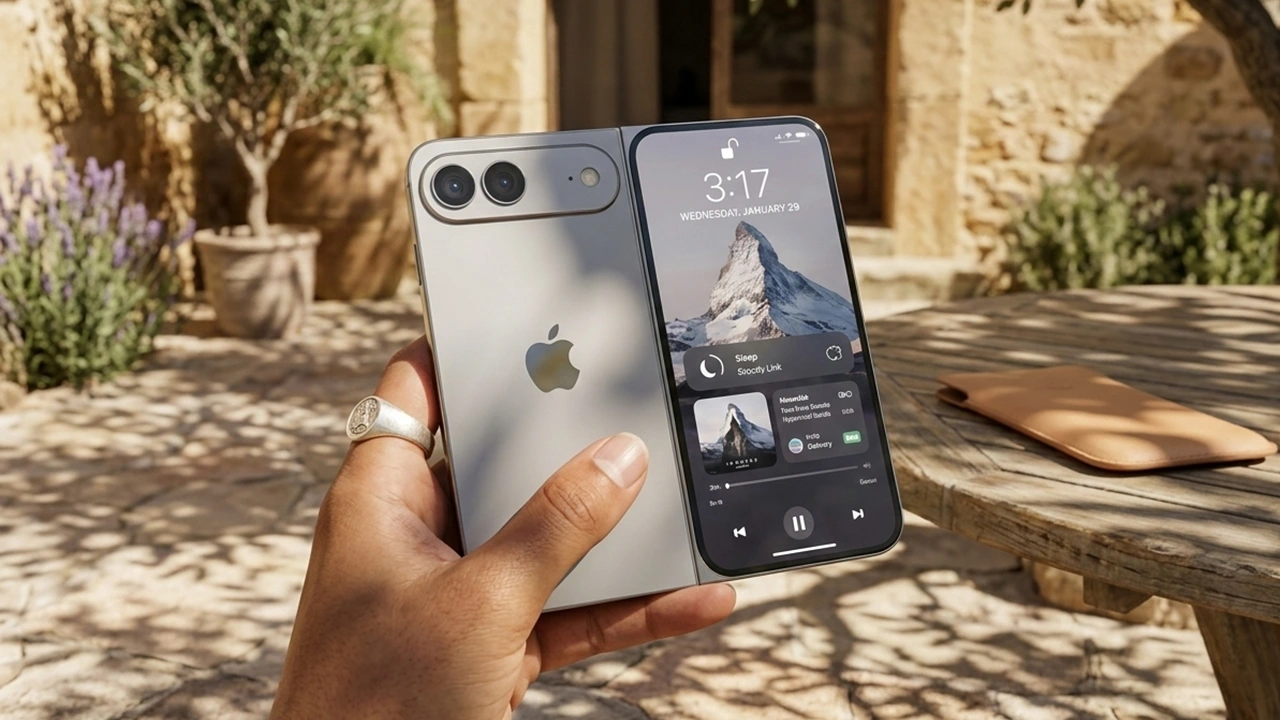
A Wide 4:3 inner display can add letterboxing for 16:9 content—great for productivity, but not always ideal for movie-first users.
The Galaxy Z Wide Fold’s screen ratio just leaked, and it tells you exactly what Samsung is planning next: a 4:3 inner display that’s built to feel like a real small tablet, not a tall phone that happens to fold. And the timing isn’t subtle.
This looks like Samsung lining up a direct answer to the rumored foldable iPhone before Apple even steps on stage.
So here’s the situation. New images were found inside One UI 9 firmware tied to a device code that’s widely expected to be Samsung’s next foldable variant: the SM-F971B.
The tentative name floating around is “Galaxy Z Wide Fold,” and the big headline is the inner screen aspect ratio.
Not a minor tweak. Not a couple millimeters wider.
A full-on shift to 4:3.
In this video, I’m going to walk through what the leak actually shows, why 4:3 matters more than people think, how it changes multitasking and media, and why this move feels like Samsung preparing for Apple’s foldable in a way that might finally make sense.
First, the leak itself.
The report claims there are images inside the One UI 9 firmware package that show device diagrams for SM-F971B. These aren’t marketing renders from a leaker’s imagination. They’re the kind of internal reference images you expect software teams to use for layout, orientation, and UI behaviors.
And those images point to a 4:3 inner display.
That’s the important part, because Samsung’s current Galaxy Z Fold approach has always been… narrow-minded. Literally.
Even as the fold line improved, the inner display has stayed close to a squarish feel. The Z Fold 7 inner screen sits around a 1.11:1 ratio, so it’s almost as tall as it is wide.
Some people love that.
But a lot of people don’t, because it creates a weird identity problem.
When a fold opens up, you want it to feel like you gained something. Like you upgraded to a tablet mode. But if the inner display still feels tall and phone-ish, you’re not really getting that “small tablet” vibe. You’re getting “bigger phone” vibes.
A 4:3 inner screen changes that immediately.
Because 4:3 is a classic tablet ratio..
It’s the iPad ratio. It’s the ratio that makes reading, web browsing, email, documents, and two-app multitasking feel natural without everything getting stretched into a tall column.
Now, quick reality check: 4:3 doesn’t magically fix every foldable problem.
You still have app optimization issues, camera compromises, thickness, weight, and the crease.
But as far as the actual day-to-day usability of the big screen goes, aspect ratio is one of those quiet decisions that affects everything.
So what does 4:3 actually do for you?
Number one: multitasking gets more useful.
On the current tall-ish Fold layout, split-screen multitasking often feels like you’re working in two skinny lanes. It’s fine in a pinch, but not great for longer sessions.
On a wider 4:3 canvas, split screen starts to look like two genuinely usable windows.
1. Email plus a document.
2. Slack plus a browser.
3. YouTube plus notes.
4. Maps plus messages.
It stops feeling like a demo feature and starts feeling like something you’d actually choose.
Number two: web browsing becomes more “tablet normal.”
A lot of websites scale in a way that looks better on wider displays. You see more horizontal layout. Columns behave more predictably. You scroll less and scan more. It’s the difference between reading a website on a phone versus using it like a mini laptop screen.
Number three: media gets a mixed, but mostly positive, upgrade.
This part needs nuance.
If you’re watching standard 16:9 video, a 4:3 screen will still have letterboxing. That’s unavoidable. But the overall experience can still be better because the video can be larger in physical size depending on the screen dimensions, and you have more usable space around it for controls, chat, or multitasking.
For newer formats, like a lot of creator content that’s shot wider, and especially for apps that use the extra space well, 4:3 is a friendlier canvas.
And number four: it signals intent.
Samsung isn’t drifting into this by accident. A ratio shift like this means the software team has to anticipate new UI placements, new scaling, new Flex Mode behaviors, and new layout defaults across the system.
That’s why the firmware detail matters. It’s Samsung telling on itself.
They’re already preparing One UI to behave like this product were real.
Now let’s talk timing, because the timing is doing a lot of heavy lifting.
A 4:3 foldable inner screen is also extremely close to what Apple is rumored to be targeting for its foldable iPhone. And whether you believe every Apple foldable rumor or not, the industry pattern is clear: Apple tends to enter categories when it thinks the form factor is ready and when it can define the “default” version of that category for mainstream buyers.
Samsung doesn’t want Apple showing up with a wide, tablet-like foldable and having the narrative become the following:
“Oh, so this is what foldables were supposed to feel like.”
Because then Samsung becomes the company that sold the awkward early versions.
So Samsung’s move here looks like positioning. Not panic, but positioning.
They’re trying to land on a form factor that the average buyer understands instantly: closed, it’s a phone. Open, it’s basically an iPad mini-style surface.
And honestly, that’s been the promise of book-style foldables from day one. Samsung is just now getting closer to delivering it in a way that feels obvious.
But why do it as a separate model?
Why not just make the Galaxy Z Fold 8 wider and call it a day?
Because Samsung has a balancing act.
There are customers who like the existing fold shape. A taller inner screen has benefits. It can be great for reading, for vertical app layouts, and for one-handed use on the cover screen depending on how the device is shaped.
If Samsung changes the core Fold identity too aggressively, they risk alienating the people who already buy it.
So a “Wide Fold” makes sense as a second track:
The regular fold continues for the current audience.
The Wide Fold tests a more tablet-first approach.
If it wins, Samsung has a new flagship foldable direction.
If it doesn’t, they haven’t burned the main line to the ground.
Now, there’s another rumored piece that matters a lot: the crease.
Both the Wide Fold and the next Fold generation are rumored to feature an almost crease-free display. And we’ve heard variations of this for years, so I’m not going to pretend a rumor equals reality.
But if Samsung actually makes a meaningful jump in crease reduction at the same time it shifts to 4:3, that combination is huge.
Because the crease is one of the last “normal person” barriers.
Tech enthusiasts tolerate it. We accept tradeoffs.
Mainstream buyers walk into a store, open the device, see a line down the middle, and immediately go, “Wait, that’s supposed to be normal?”
If Samsung can make the crease less obvious and make the inner screen feel more like a real tablet, that’s a much cleaner pitch.
Now stack on the software story.
The leak is tied to One UI 9, and the expectation is Android 17 out of the box. Again, release timing can change, but the point is, Samsung is building the software foundation now.
And software is where foldables live or die.
A wider aspect ratio is only great if Samsung’s multitasking UI, app continuity, keyboard behavior, and split-screen defaults are tuned for it.
If they nail that, 4:3 becomes a productivity win, not just a spec sheet line.
Now I want to address the obvious comparison people are already making:
“Samsung is copying Apple before Apple even ships.”
Samsung has been aggressively working on thinness and hinge engineering. The Fold 7 reportedly got significantly slimmer, with Samsung borrowing design and manufacturing lessons from its super-thin phone efforts. When you shave millimeters off a fold, you don’t just make it prettier. You make it more livable.
A wider fold can easily get heavy and awkward.
So the only way a Wide Fold works is if Samsung keeps thickness and weight under control.
And that might be the real story behind why this is happening now:
Samsung’s hinge and internal packaging have improved enough that a wider device doesn’t automatically mean an uncomfortable device.
Also, Samsung has been experimenting in public.
We’ve seen concepts. We’ve seen weird form factors. We’ve seen the tri-fold idea. Not everything ships, and not everything should ship, but Samsung has clearly been collecting data on what people actually want.
And it also helps that Samsung has already tested “wider than normal” with special editions and incremental widening over the years. They didn’t wake up yesterday and discover width.
So here’s the bigger takeaway.
A 4:3 Galaxy Z Wide Fold would be Samsung admitting something important:
The best version of a book-style foldable is not a tall phone that opens into a bigger tall phone.
It’s a phone that opens into a tablet shape people already understand.
And if Apple is coming with a foldable iPhone that aims at mainstream acceptance, Samsung’s best defense is to offer a product that feels just as natural, just as polished, and ideally more mature because Samsung has been doing foldables for years.
Now, before we get carried away, a few things still need answers.
How wide is the cover display, and is it finally “normal phone” comfortable?
What’s the camera system like, and does Samsung compromise it to keep the device thin?
What’s the battery capacity, and does a bigger display mean worse endurance?
And the big one: price.
Because a “wide fold” positioned as an extra model could land at an extra-premium price, and that can limit how big of an impact it actually has.
But purely on the design signal, 4:3 is the most interesting Fold-related leak we’ve had in a while.
It’s a choice that changes the experience, not just the spec sheet.
If you want, I can do a follow-up the moment we get more concrete details on the Wide Fold’s size, cover screen dimensions, and whether that crease reduction rumor is real. So subscribe for that.
And comment “4:3” if you think this is the ratio foldables should’ve had from the start, or “square” if you prefer Samsung’s current approach.
The Wide Fold leak isn’t just a random firmware find. It’s a glimpse at Samsung’s strategy: widen the canvas, polish the hardware, and make the foldable feel more like a tablet people already know how to use.
If Apple is preparing a foldable iPhone, Samsung doesn’t want to compete with yesterday’s Fold. It wants to compete with the form factor that wins the next wave.
Read more:

Hmm, I kinda like the idea of a 4:3 screen tbh. Feels more like a mini tablet when opened, which would be nice for browsing and work. But yeah, watching Netflix or YouTube might not look as good with those black bars. Still interesting direction though.
Tcontech thanks for Sharing this effective post
These changes brought by the iPhone 18 Pro and Pro Max are quite positive. A larger battery means longer backup, which is always a relief for users. And the new A20 processor will make performance faster and more powerful. All in all, Apple is going to give big updates in both battery life and speed in their next flagship.
4:3 ratio might be great for work, but yeah… not ideal for video lovers.
I get why they’re going with 4:3, but yeah… most of what I watch is 16:9, so it might feel a bit off. Could be amazing for work stuff though, so I guess it depends how you use your phone.
Interesting take on the 4:3 wide fold leak. It sounds cool at first, but the impact on video quality could be a real drawback. Definitely something creators should keep an eye on before getting too excited about new form factors.
Interesting take, but I’m not fully convinced the 4:3 wide fold is a downgrade. Sure, it might not be ideal for watching standard widescreen videos without black bars, but it could be a big win for multitasking, reading, and productivity. A squarer display often feels more natural for apps and browsing. It really comes down to how people use their phones daily—media lovers might notice the downside, but power users could actually prefer this shift.
Interesting leak! A 4:3 wide fold sounds bold, but it might not be ideal for video viewing. Curious to see how it plays out. 🤔📱
It feels like a bold move to redefine what foldables are meant for, rather than just chasing the usual smartphone experience.
Wow.. This is a very important and helpful good opportunity for the all peoples in the world.. great job..
Really interesting topic. I appreciate the effort you put into writing this.
iphones are very costly but it security satisfied me
This mobile is very good
This company is one of the best in the world
This company is a special company
I think it’s much more focusing on work purposes. These for users who are want official daily little task and can also do multimedia consumption.
Amazing product
Very interesting read. The details provided are clear and engaging. It helped me understand the topic better. Thanks for sharing this valuable information.
Amazing work 👍.
Very nice feature
Great information
A 4:3 wide fold sounds interesting, but if it compromises video experience, that’s a big drawback. Let’s see how they handle it.
Informative post
Nice Experience ✅.
Very interesting and insightful article. The details about the 4:3 wide fold issue were explained really well. It’s great to see such in depth coverage on how this could impact video quality. Thanks for sharing such valuable information.
I love the wider display for multitasking, but watching videos with those black bars can be distracting. Let’s see if software optimization can bridge the gap for a better cinematic experience.”
Big screen, but big black bars? Not sure if that’s the trade-off I want for videos.
Big screen, but big black bars? Not sure if that’s the trade-off I want for videos.
Amazing phone…
Honestly, this is a smart move from Samsung, but it really depends on how people use their phones. The 4:3 ratio sounds great for multitasking and productivity, especially if you treat it like a mini tablet. But for those who mainly watch videos, the letterboxing might not be ideal.
If Samsung can reduce the crease and keep the device thin, this could end up being one of the most practical foldables so far. It feels like they are finally pushing toward a design that feels natural instead of experimental.
There is a logical point in this article which point is Email plus a document.
The 4:3 ratio could improve multitasking, though video lovers may have concerns.
Can you give me more deatils this phone
Effective news
There is many information about this phone that is really helpful.
That’s amazing
I like to larn more
That curbed screen doesn’t look good to me.
Overall this phone Amazing
Interesting take, a 4:3 display sounds great for productivity, but I can see how it might not be ideal for watching widescreen videos.
A 4:3 foldable might look great for productivity, but for video it’s a mixed bag—expect bigger black bars and awkward framing unless apps adapt properly.
That 4:3 fold idea is interesting, but I can see how it might mess with video viewing.
Really curious how they’ll balance screen design with actual everyday usability.
Very strong phone
!
😮 Samsung Galaxy Z Wide Fold’s 4:3 display is a really interesting move!
It may be perfect for productivity and multitasking, but there may be a bit of a compromise for 16:9 video lovers 🎬
Samsung seems to be taking a clear strategy—“work first, entertainment later” 🤔
Let’s see how the balance plays out in real-life usage!
Great for productivity, but video lovers may dislike black bars daily.
Thank you for sharing us this important article.
amazing review
Unbailable, Galaxy in crazy
Really insightful analysis. Loved how you explained the 4:3 trade-offs between productivity and media consumption clearly.
An unrealistic race?
This article is very informative.. all points of this article really greatest.
Effective news
This is simply the best
Great experience
I think iphone fold would be a interesting phone for apple lover
The idea of a 4:3 wide fold design is quite unique, but I can see how it might affect video quality. I liked how you explained both the advantages and possible drawbacks. It made the topic easier to understand and more engaging to read.
Thanks for instructions
It’s very awesome company
This is an interesting concept for foldable devices, but the 4:3 ratio could affect video playback and user experience. It will depend on how apps adapt to it.
“Interesting leak, but honestly if videos don’t look right on a 4:3 fold, that could be a deal breaker for a lot of people 👀”
Foldable device i like
good
Best article
Wow great this is a message information to everyone, which help us to take a correct decision
Iphone smooth
iphones are very costly
A 4:3 foldable sounds interesting for reading or multitasking, but for videos it might feel awkward with those black bars. If this leak is true, it seems like a trade-off between productivity and entertainment.
So informative
That sounds like a step backward—if a wider fold compromises video quality, it defeats the purpose of a premium display. Curious to see if it’s a real issue or just early leak hype.
Amazing Product.
Wow…. Wonderful projects… I have participated in following the guidelines and rules of this project. I am sure that it will develop and be successful in the future .
Sad , if too much costly cell phone making such issues
This is a very interesting and insightful article. I really appreciate how you explained the potential impact of the 4:3 wide fold design on video quality. The way you broke down the technical aspects into simple explanations made it easy to understand for readers like me.
The excessive type of iPhone, I think it’s the best phone iPhone from the others
The excessive type of iPhone, I think it’s the best phone iPhone from the others
Is apple really work on folding phone’s this is great news
Great features
Nice one Boss
It’s a tough trade-off. While the 4:3 ratio is a dream for productivity, the black bars during movies might be a dealbreaker for heavy media consumers. Interesting dilemma 😭
Interesting perspective! The 4:3 Wide Fold leak is exciting for productivity, but I agree it could raise concerns for video viewing if content ends up with bigger black bars or awkward scaling. It’ll be interesting to see how Samsung balances multitasking benefits with media consumption
Very informative post
Good news bro
Interesting take—if Samsung really goes for a 4:3 wide fold design, it could change how content looks, especially for videos and streaming. Let’s see how it performs in real use!
Thanks for Sharing this post
Favourite one
The 4:3 wide fold concept is definitely intriguing, but it could impact the video viewing experience in unexpected ways. Curious to see how brands balance innovation with usability here.
A 4:3 foldable sounds great for productivity and reading, but for video it’s a real trade-off. Most content is shot in 16:9 or even vertical, so you’ll end up with black bars or awkward cropping. Unless apps optimize properly, that “bigger screen” might not actually feel better for watching videos.
Good 😊
“Very informative, thanks!”
A brilliant community for tech lovers. Thanks for providing such high-quality updates and insights!