Apple’s long modem project is reportedly ready for its biggest moment yet: the iPhone 18 Pro and iPhone 18 Pro Max may ship with a next-generation Apple-designed C2 cellular modem, moving away from the Qualcomm 5G modem expected in the iPhone 17 Pro line.
That change sounds technical, but it’s the kind of under-the-hood upgrade that can alter how the phone feels every day. The rumor isn’t just about Apple “owning more of the stack.” If C2 follows the trajectory of Apple’s earlier C-class modems, it brings three practical advantages that matter to people who actually use their phones off Wi‑Fi: battery life, privacy, and performance when networks get messy.
Here’s what to watch for as the iPhone 18 Pro lineup comes into focus.
The shift: Apple modem replaces Qualcomm in the Pro line
For years, Qualcomm modems have been the connective tissue behind iPhone 5G, handling everything from tower handoffs to data scheduling. But Apple has been steadily building toward independence, and the rumored C2 inside iPhone 18 Pro represents a more complete handoff: an Apple modem designed to work hand-in-glove with iOS, Apple’s A‑series application processor, and Apple’s wireless stack.
That tight coupling is the real story. A modem is not just a “signal chip.” It’s constantly negotiating power states, measuring network conditions, prioritizing packets, and deciding when to ramp radios up or down. When Apple controls the software and silicon on both sides of that relationship, it can optimize behaviors that are hard to coordinate across vendors.
The result won’t be marketed like a new camera button, but you’ll feel it in the places that frustrate iPhone owners most: when battery drops faster than expected on 5G, when location privacy feels out of your control, and when “full bars” still produces laggy apps.
Advantage 1: Better battery efficiency on cellular
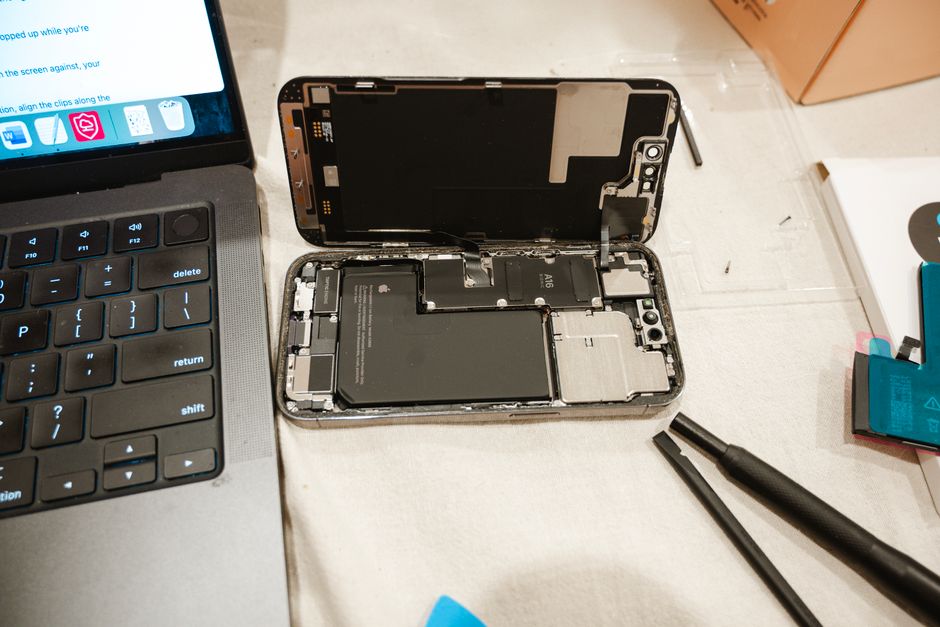
Battery efficiency is expected to be the headline benefit of C2, and it’s also the most believable one. Apple’s first-generation modem efforts have already been associated with power gains on products like iPhone 16e, iPhone Air, and the M5 iPad Pro, even though Apple hasn’t put hard percentages on stage.
The logic is straightforward. Cellular radios are among the most power-hungry components in a smartphone, especially in mixed conditions: commuting, indoors, switching towers, falling back between 5G and LTE, or clinging to a weak signal. Qualcomm modems are excellent, but Apple’s edge is integration: iOS can coordinate app behavior, background fetch, and radio scheduling with deeper awareness of the modem’s state, and Apple can design power management pathways that don’t require compromises for a third-party chip.
How big could the C2 gains be? Nobody outside Apple can responsibly quote a number yet, but the direction is clear: if iPhone 18 Pro is also rumored to carry a larger battery than iPhone 17 Pro, the combination of more capacity plus a more efficient modem can compound. That’s the kind of change that turns “I should bring a charger” into “I’m fine until bedtime,” especially for people who spend a lot of time on 5G.
Advantage 2: Limit Precise Location privacy for carriers
The most interesting C2 benefit might be the one people aren’t expecting: a privacy feature.
Apple added a setting in iOS called “Limit Precise Location” that’s currently available only on devices using an Apple-designed modem. The goal is simple: reduce how precisely your cellular carrier can infer your location based on which towers your device connects to.
Apple’s documentation explains it clearly: cellular networks can determine your location via tower connections, and with this setting enabled, the precision of location data available to cellular networks is reduced. That can mean the network may identify your neighborhood rather than a specific street address. Apple also notes that it doesn’t impact signal quality or user experience.
At the moment, support is limited to a short list, including iPhone Air, iPhone 17e and 16e, and the M5 iPad Pro. If iPhone 18 Pro indeed adopts C2, it should join that club.
This is an unusually direct privacy move because it’s not about hiding from apps. It’s about limiting what the network learns by default. If you care about location privacy, it’s hard to overstate how meaningful it is to see Apple treat the carrier relationship as another surface area worth defending.
Advantage 3: Faster-feeling data in congested networks
A third advantage is performance, but not the kind that shows up in a perfect lab test. It’s about tough coverage: crowded stadiums, conventions, train stations, dense apartments, or any place where you have bars but everything feels delayed.
Apple has described an integration-driven approach to this problem. In a comment to Reuters, Apple explained that if an iPhone encounters congested data networks, the phone’s processor can signal to the modem which traffic is most time sensitive and prioritize it over other transfers.
That matters because “speed” is often not the real complaint. Responsiveness is. If your messages send instantly while a big background photo upload takes longer, the phone feels snappy even when bandwidth is constrained. Prioritizing the right packets at the right moment is exactly the kind of system-level coordination Apple can do better when the A‑series processor and C‑series modem are designed as a pair.
If C2 brings more of that behavior to the Pro line, the payoff is subtle but addictive: fewer moments where you stare at a spinner wondering if the network is broken.
What it means for iPhone 18 vs iPhone 18 Pro specs
The C2 modem rumor also intersects with broader iPhone 18 chatter, especially around battery life, displays, and RAM strategy.
Apple hinted at longevity and future-proofing during WWDC 2026, emphasizing how additional memory helps devices keep more features over time. The iPhone 18 Pro and Pro Max are widely expected to handle a jump to 12GB of RAM without drama, but the base iPhone 18 is where supply constraints could force tradeoffs due to ongoing DRAM shortages.
One rumored compromise: Apple could keep costs stable by pairing 12GB of RAM with a previous-generation OLED panel (for example, stepping back from an M14 panel to an M12+ OLED), rather than pushing both upgrades at once. For many buyers, that swap would be nearly invisible day-to-day, because most people don’t “pixel peep” OLED differences the way enthusiasts do. The more noticeable impact might be a slightly different power profile, but Apple has other levers to pull.
That’s where the platform matters: a 2nm A20-class chip paired with a C2 5G modem and updated wireless silicon could offset a lot of the battery hit, while 12GB of RAM would meaningfully improve multitasking, reduce app reloads, and smooth out demanding games that are increasingly console-like.
In other words, Apple’s modem roadmap doesn’t live in isolation. It’s part of a wider push to make iPhone feel more consistent: longer-lasting, more private, and more stable under pressure.
Conclusion
If the iPhone 18 Pro really does ship with Apple’s C2 modem, the upgrade isn’t just about replacing Qualcomm. It’s about Apple turning cellular into another area where it can differentiate through integration.
The three advantages to watch are straightforward and practical: improved battery efficiency on 5G, the arrival of “Limit Precise Location” for better carrier-level privacy, and smarter performance in congested networks that makes the phone feel faster when conditions are worst.
Now the big question is execution. If Apple can deliver those gains without first-generation hiccups, the C2 could end up being one of the most important iPhone 18 Pro features, even if it’s the one most people never see on a spec sheet.
Read more: iPhone 18 Pro C2 modem: 3 upgrades over iPhone 17 Pro
iPhone 18 Pro Price: The Upgrade Will Cost More Over Time
Apple Watch Ultra 4 rumors: redesign, sensors, and doubt
iPhone 18 Pro leak hints at a smaller Dynamic Island