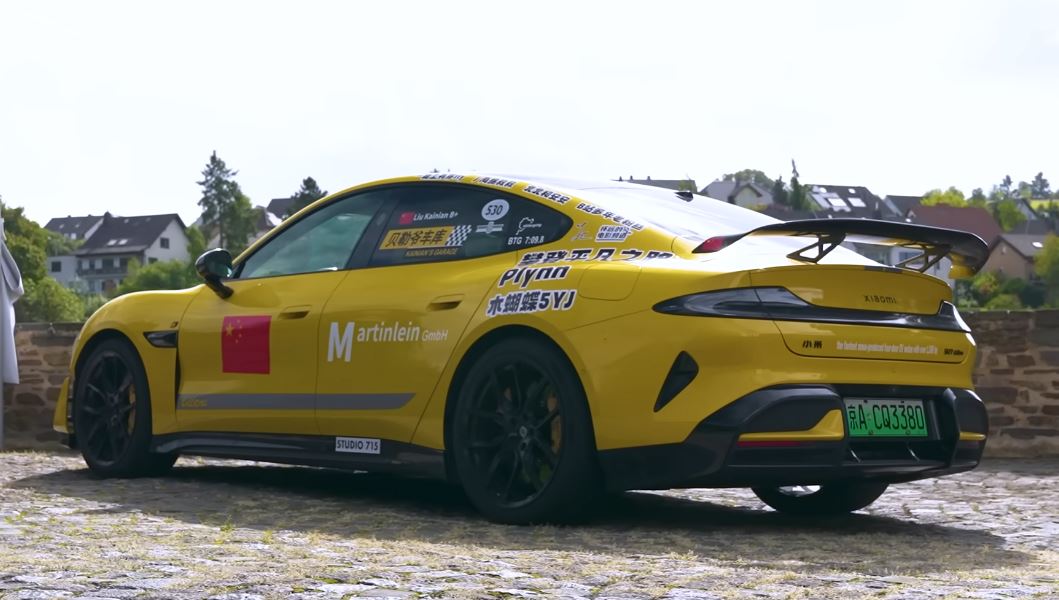
Xiaomi is best known for phones, wearables, smart-home gear, and scooters. Now it’s building a car that reads like a spec-sheet dare: the Xiaomi SU7 Ultra, a mass-produced four-door EV sedan with 1,548 horsepower and hypercar-baiting torque.
On paper, it’s the sort of machine you’d expect to sit well north of six figures. Yet in China it starts at the equivalent of around £50,000 or 92,700.00 €, a figure that reframes almost every conversation about high-performance EVs. Xiaomi’s stated European ambitions land later (the company has discussed a Europe launch window around 2027), and pricing outside China will change. Even with an estimated European sticker closer to £80,000, the value proposition remains hard to ignore.
The bigger story isn’t just straight-line speed. It’s what the SU7 Ultra implies: a consumer-electronics giant is applying Silicon Valley-style iteration, supply-chain leverage, and UI-first thinking to a segment currently dominated by legacy performance brands and a handful of EV leaders.
The headline numbers: power, pace, and Nürburgring credibility
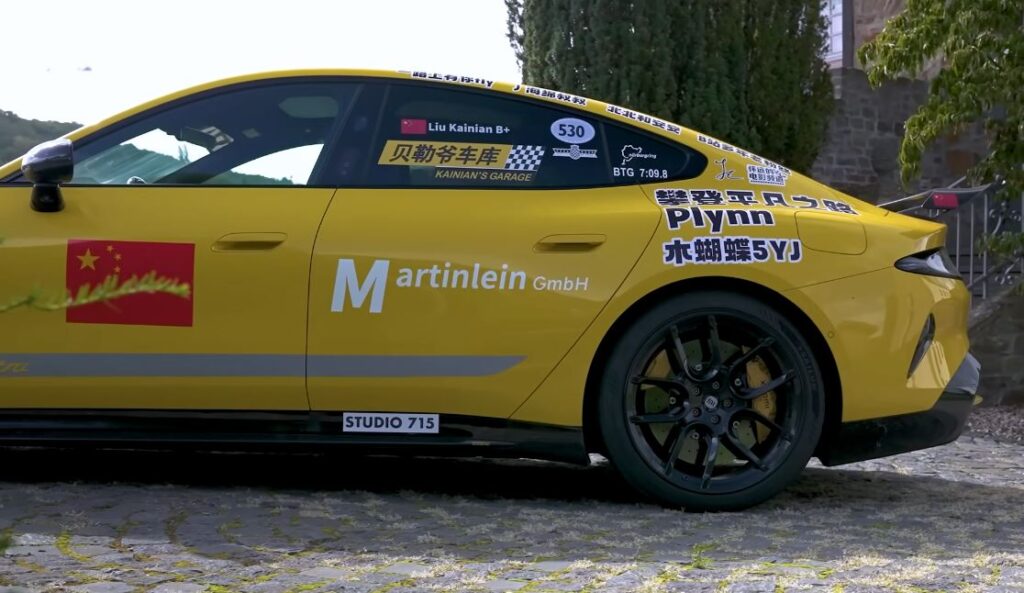
The SU7 range starts modestly enough: an entry-level single-motor version with about 299 horsepower and 400 Nm. The Ultra is the opposite end of the spectrum. It uses a tri-motor setup (two motors at the rear axle, one up front), a layout familiar from cars like the Tesla Model S Plaid, but pushed further.
Key figures being discussed for the SU7 Ultra include: 1,548 horsepower approximately 1,770 Nm of torque a 93 kWh battery kerb weight around 2.3 tonnes claimed top speed of 217 mph
Then there’s the Nürburgring reference point. A lap time quoted around 7 minutes 4 seconds puts it into serious company for a four-door vehicle, and it’s notably quicker than the fastest widely cited Model S Nürburgring time of about 7 minutes 25 seconds. Track times are always subject to conditions, tires, and configuration, but the direction of travel is clear: Xiaomi isn’t launching with a “pretty good for a first attempt” car. It’s aiming directly at the EV performance establishment.
For a tech audience, the Nürburgring number matters less as bragging rights and more as a systems validation: thermal management, inverter robustness, sustained power delivery, and braking performance are where high-output EVs tend to reveal their weak points.
Design and hardware: where Xiaomi borrows, and where it innovates
Visually, the SU7 Ultra is candid about its influences. The front lighting has been compared to the McLaren 720S, and the sedan silhouette lands in Porsche Taycan territory. That’s not necessarily a criticism; it’s a pragmatic move for a first-generation vehicle designed to compete in a premium segment where proportions and stance telegraph intent.
The Ultra-specific exterior changes aren’t just cosmetic. Xiaomi says its more aggressive front apron improves battery cooling by about 10 percent over the standard car. That’s the kind of detail that matters if you’re genuinely trying to deliver repeatable performance rather than a single heroic run.
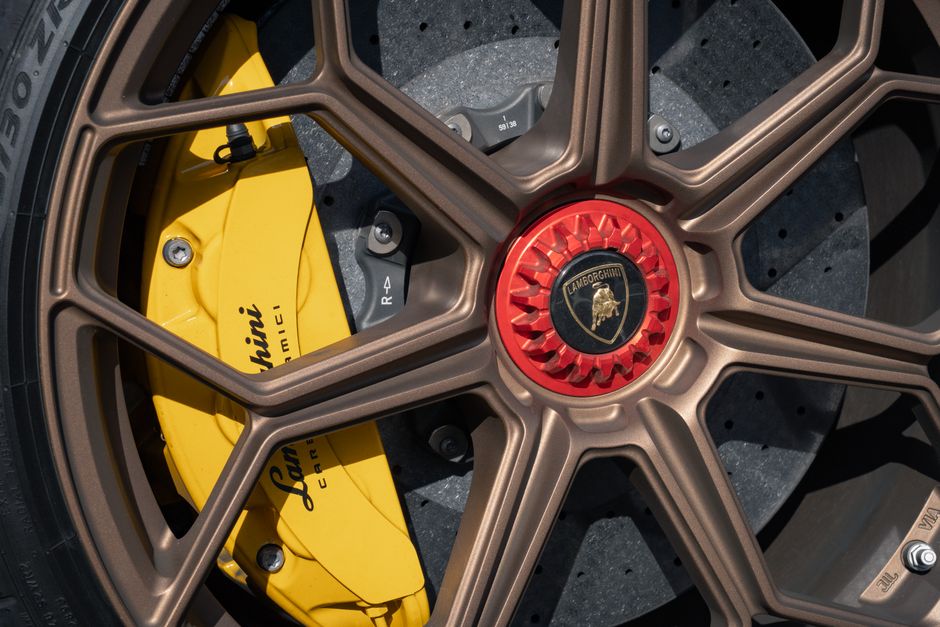
Hardware highlights that stand out at this price point (especially in China) include: 21-inch wheels carbon-ceramic brakes as standard optional carbon-fibre roof (some cars shown with glass roof) an upgraded optional rear wing an electronically actuated rear diffuser flap (active aero on a mainstream-priced sedan is still rare)
There’s also a telling under-the-skin clue: a plaque referencing a 27,000 RPM motor speed. Many EV traction motors spin closer to roughly 21,000 RPM in common implementations. Higher motor RPM can support different gearing strategies and potentially improve high-speed performance, but it also raises engineering demands around bearings, cooling, and power electronics.
A separate talking point is the battery protection structure. Xiaomi has publicly demonstrated the strength of the battery casing material in dramatic fashion, positioning it as a safety-led design choice to reduce puncture risk in severe impacts. Whether that translates to measurable real-world safety advantages will depend on independent testing, but it signals Xiaomi’s awareness that EV fires, however statistically uncommon, are a trust issue.
Cabin tech: phone-company DNA, fast processors, and clever details
Step inside and the “consumer electronics company built this” vibe is immediate, but not in the cheap way people used to associate with early touchscreen-heavy cabins.
The SU7 Ultra’s interior leans into a two-tone sport theme (notably yellow accents on some examples), with carbon-fibre trim and Alcantara headlining appearing in places you wouldn’t expect at the China-market entry price. Material quality reportedly varies as you go lower down the cabin, but the overall impression is closer to premium than budget.
The interface story is where Xiaomi’s background becomes an advantage: A large central screen with fast response (Chinese OEMs have been consistently strong here due to modern SoCs and UI priorities) High-definition camera views that look genuinely cutting-edge Apple CarPlay support A big head-up display A rotating driver display that reveals itself as part of a playful “startup” sequence
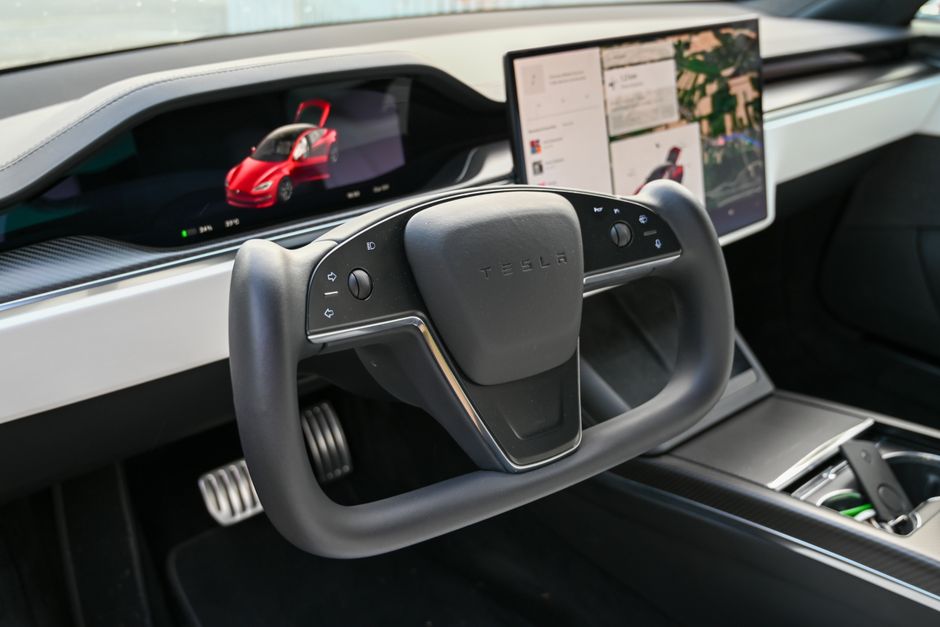
Not everything is perfectly intuitive. Some controls, like steering wheel adjustment, are buried in on-screen menus, echoing Tesla’s approach. That’s efficient for manufacturing and software updates, but it adds friction for first-time users. Xiaomi’s UI appears to offer a quick language change hack that flips the interface from Chinese to English, which is useful for imports but also a reminder: localization is a product, not a toggle, and Europe will demand a deeper, regulation-aligned software experience.
Practical tech touches also stand out: Cooled wireless phone charging rated around 50W USB-C ports rated around 67W Multiple storage compartments and large door bins
Rear-seat space is described as strong for a sedan with a battery underfloor, though the typical EV compromise remains: rear bench height can reduce under-thigh support. The boot is quoted at 454 litres, slightly larger than a comparable Taycan sedan, and the rear seats fold for longer loads.
Even the “small stuff” feels engineered: a vanity mirror with adjustable brightness and tone sounds trivial until you remember how many cars still treat interior lighting like an afterthought.
Real-world performance: launches, heat limits, and quarter-mile truth
The Ultra’s acceleration numbers are the kind that break normal consumer categories. Xiaomi has claimed 0–60 mph in 1.98 seconds, but independent runs described nearer 2.79 seconds. That difference is meaningful, yet 2.79 seconds is still brutally quick for a 2.3-tonne four-door.
More revealing than the best run is what happens after repeated launches.
In drag testing against highly tuned internal-combustion monsters, including a Nissan GT-R and a Lamborghini with power figures in the 1,400–1,500 wheel-horsepower range, the SU7 Ultra recorded a standing quarter-mile as quick as 9.4 seconds when it delivered full power. That’s in the same neighborhood as a Bugatti Chiron Pure Sport’s quarter-mile performance, a comparison that would have sounded absurd for a £50,000-equivalent sedan even five years ago.
But repeated runs exposed a familiar EV constraint: heat. After multiple full-power launches, the car reportedly overheated and reduced power output to protect the battery and drivetrain. In a later run while thermally limited, the SU7 Ultra posted a slower 10.5 seconds, while the GT-R ran 9.1 seconds and took the win.
For tech-minded readers, this is the real takeaway: Peak power is a marketing number. Sustained power is an engineering signature.
Xiaomi appears to be managing power delivery progressively, more like a high-performance ICE car building speed rather than the immediate neck-snap of some EVs. That’s not inherently slower; it can be a traction strategy and a drivability choice. It may also be why the car feels less violent than a Model S Plaid off the line, while still piling on speed hard once it hooks up.
The Ultra also introduces a mode structure that feels like an app ecosystem: Economy, Standard, Sport with increasing power levels A separate “Race app” that unlocks track-focused modes such as qualifying and endurance A boost button that temporarily raises output Adjustable steering, regen, and torque distribution options, including rear-drive drift-oriented settings
This approach is very “Xiaomi”: create layers of capability, gate the highest-risk performance behind explicit UI choices, and let advanced users fine-tune.
There’s also talk of a track pack with upgraded pads, track-oriented tires, and coilovers replacing air suspension. That’s a pragmatic nod to how serious track users actually prep cars, and it suggests Xiaomi expects the Ultra to see circuit use, not just social-media launches.
The catch for Europe: charging, software, and ownership realities

The SU7 Ultra looks like a bargain rocket when priced for China. But Europe is where product-market fit gets complicated.
Charging is a prime example. In China, the platform is associated with extremely high peak charging rates (figures approaching 500 kW are discussed). In Europe, if the vehicle arrives with a China-market charging architecture requiring adapters, peak charging can fall dramatically (reports suggest around 130 kW when using an adapter). Even if Xiaomi ships a Europe-native port configuration later, charging performance will depend on local infrastructure, battery preconditioning strategy, and compatibility with networks that can be temperamental even for established brands.
Autonomy and driver-assistance features are another friction point. The vehicle includes a roof-mounted lidar unit, implying high ambitions for advanced self-driving capability. But outside its home market, those features can be limited by regulations, mapping, validation requirements, and liability concerns. The result: you may have the hardware, but you’re mainly using conventional adaptive cruise control and lane support.
There are also ownership-paper-cut issues that tech people will recognize from phones and laptops: Ecosystem favoritism: connectivity is rumored to be smoother with Xiaomi and Apple devices than with certain competitors Camera placement: a low rear camera without a washer can become a genuine usability issue in winter grime Brake noise: high-performance pads and ceramics can squeal, and owners expecting silent EV operation may be surprised
One specific controversy worth noting is Xiaomi’s now-removed carbon bonnet option with a scoop that buyers believed was functional. It became a reputational issue when it turned out not to provide the implied performance benefit. For a new automaker, trust is currency, and early missteps linger.
Verdict: disruptive value, with early-adopter caveats
The Xiaomi SU7 Ultra lands with a message that incumbents can’t ignore: outrageous performance is being productized, and the price curve is bending fast. A four-door EV with 1,548 horsepower, active aero elements, a premium-feeling cabin, and tech-forward UI shouldn’t be able to exist at anything near mainstream luxury money, yet here it is.
At the same time, the SU7 Ultra also demonstrates the gap between building a staggering prototype-like road car and delivering a fully mature global product: Thermal limits under repeated hard use remain a real constraint Braking calibration (especially transitions from regen to friction) can affect driver confidence Europe-specific charging and software realities could blunt the headline advantages Early feature controversies show Xiaomi will be held to the same transparency expectations as established automakers
For tech buyers, the decision eventually won’t be “is it fast?” It will be: How consistent is it after three launches, not one? How quickly does Xiaomi patch, update, and improve real-world issues? How does service, parts availability, and warranty support work outside China? What does the second year of ownership look like, not just the first week?
If Xiaomi can answer those questions at scale, the SU7 Ultra won’t merely be a fast EV. It will be a sign that the smartphone era of product velocity has arrived in performance cars.
Conclusion
The SU7 Ultra is both thrilling and slightly unsettling, and that’s the point. It compresses supercar-level output, track-capable hardware, and consumer-electronics-grade interfaces into a price bracket that forces uncomfortable comparisons. Even if European pricing climbs, the performance-per-pound equation remains aggressive.
The most important detail is not the 1,548 horsepower headline. It’s the implication that a new entrant can iterate quickly, ship advanced tech at scale, and make legacy performance pricing look inflated. If Xiaomi follows through with reliable global support and Europe-ready charging and software, the established order in high-performance EV sedans is going to have to move faster than it’s used to.